ENARSI Troubleshooting Labs
42 broken networks to fix, covering the hands-on topics of all four 300-410 ENARSI v1.1 exam domains. Each one was built and tested on Cisco IOS XE 17.18.
What’s inside
Practice, structured like a course.
42 troubleshooting labs
A ticket, a topology, constraints and tasks. Then a verification table, the tested solution, common mistakes and review questions.
A primer before every lab
The key ideas and the commands that help, written so they don’t give the faults away.
An 8-week study plan
Mapped to Cisco’s official exam weights, with a progress tracker and a redo list for the labs you found hard.
Ready-made lab files
The complete base configurations for every router, plus GNS3 projects that open straight into the broken network.
All four exam domains
42 labs across the four exam domains.
The percentages are Cisco’s official weights for each domain. Three topics aren’t labs, because they only ask you to describe a feature or need equipment a home lab doesn’t have: IPv6 First Hop Security, Catalyst Center Assurance and model-driven telemetry. Study those from your main source.
1.0 Layer 3 Technologies
35%26 labs · Administrative distance, route maps, redistribution, summarisation, PBR, VRF-Lite, BFD, EIGRP, OSPF and BGP
- 01Wrong Path: AD, Floating Statics and BGP Backdoor
- 02Route Maps: Tags, Filters and Metric Types
- 03Split Horizon on a DMVPN Hub
- 04Mutual Redistribution: Missing Routes and Seed Metrics
- 05Two-Point Redistribution: Suboptimal Paths and Tags
- 06Summarization in OSPF and EIGRP
- 07Policy-Based Routing
- 08VRF-Lite with OSPF
- 09BFD for Fast OSPF Failover
- 10EIGRP Neighbours That Won't Form
- 11Feasible Successors and the Feasibility Condition
- 12EIGRP Stub Routing and Leak Maps
- 13EIGRP Metrics and Unequal-Cost Load Balancing
- 14EIGRP Named Mode: IPv4, IPv6 and VRF
- 15OSPF Adjacency Troubleshooting
- 16OSPF Network Types
- 17OSPF Stub, Totally Stubby and NSSA Areas
- 18OSPF Virtual Links and Transit Areas
- 19OSPF Path Preference: E1 vs E2
- 20OSPFv3 Address Families
- 21BGP Neighbours: Update-Source, Multihop, Next-Hop-Self
- 22BGP Authentication, AS Numbers and Route Refresh
- 23BGP Best-Path Selection
- 24BGP Route Reflector
- 25BGP Filtering: Prefix Lists, AS-Path Filters and Route Maps
- 26BGP for IPv6 and VRF-Lite
2.0 VPN Technologies
20%5 labs · MPLS, L3VPN, DMVPN and IPsec
- 27MPLS Basics: LDP, Labels and LSPs
- 28MPLS Layer 3 VPN
- 29DMVPN: mGRE and NHRP Registration
- 30DMVPN Phase 3: Spoke-to-Spoke Tunnels
- 31Securing DMVPN with IPsec
3.0 Infrastructure Security
20%5 labs · AAA, ACLs, IPv6 filters, uRPF, CoPP and device access
- 32AAA Method Lists and Fallback
- 33IPv4 ACLs: Standard, Extended and Time-Based
- 34IPv6 Traffic Filters and uRPF
- 35Control Plane Policing
- 36Device Management: SSH, SCP and VTY Access
4.0 Infrastructure Services
25%5 labs · SNMP, logging, DHCP, IP SLA and NetFlow
- 37SNMP v2c and v3
- 38Logging, Syslog and Conditional Debugs
- 39DHCP for IPv4 and IPv6 with Relay
- 40IP SLA and Object Tracking
- 41Flexible NetFlow
Capstone
1 lab · Three tickets and five faults across the whole network
- 42Capstone: Troubleshooting Day
From Lab 15
Four sites, four contractors, four different faults.
“Four new sites were connected to the core router R1 tonight. Not one of them shows up in OSPF. Each site was configured by a different contractor.”
R1# show ip ospf neighbor
Neighbor ID     Pri   State           Dead Time   Address
2.2.2.2           1   EXCHANGE/DR     00:00:35    10.0.12.2
Real output from the lab, IOS XE 17.18. Why is it stuck there?
See inside
Real pages from the workbook.
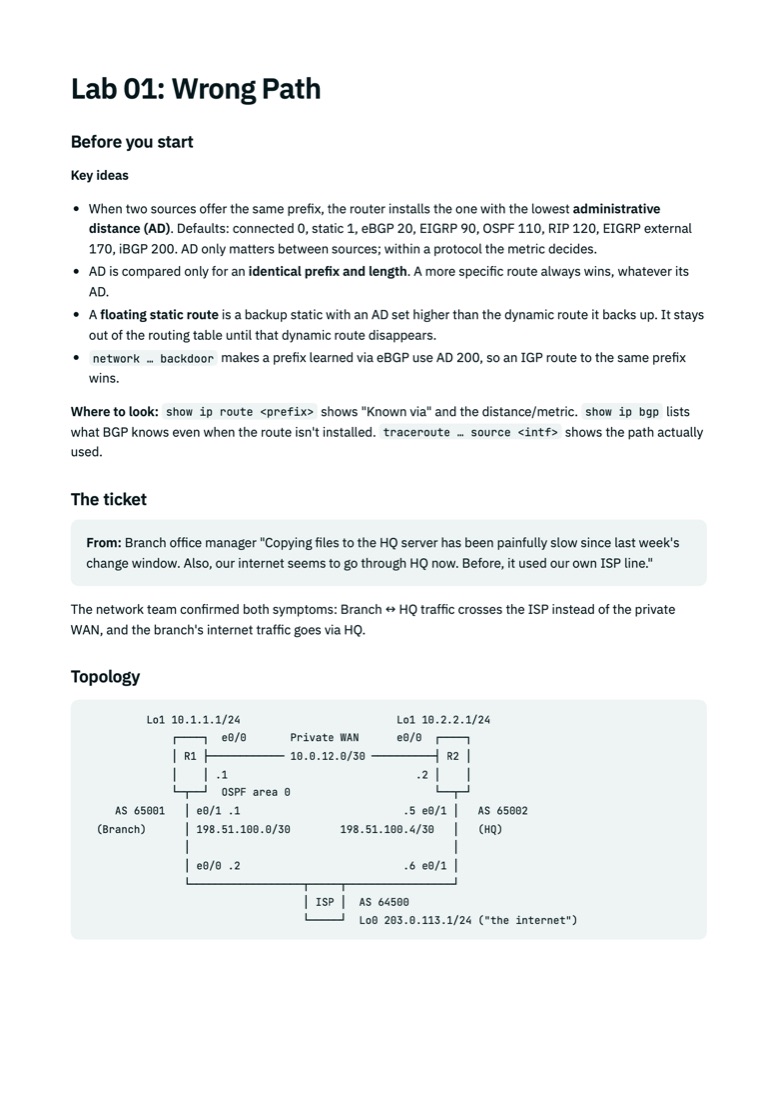
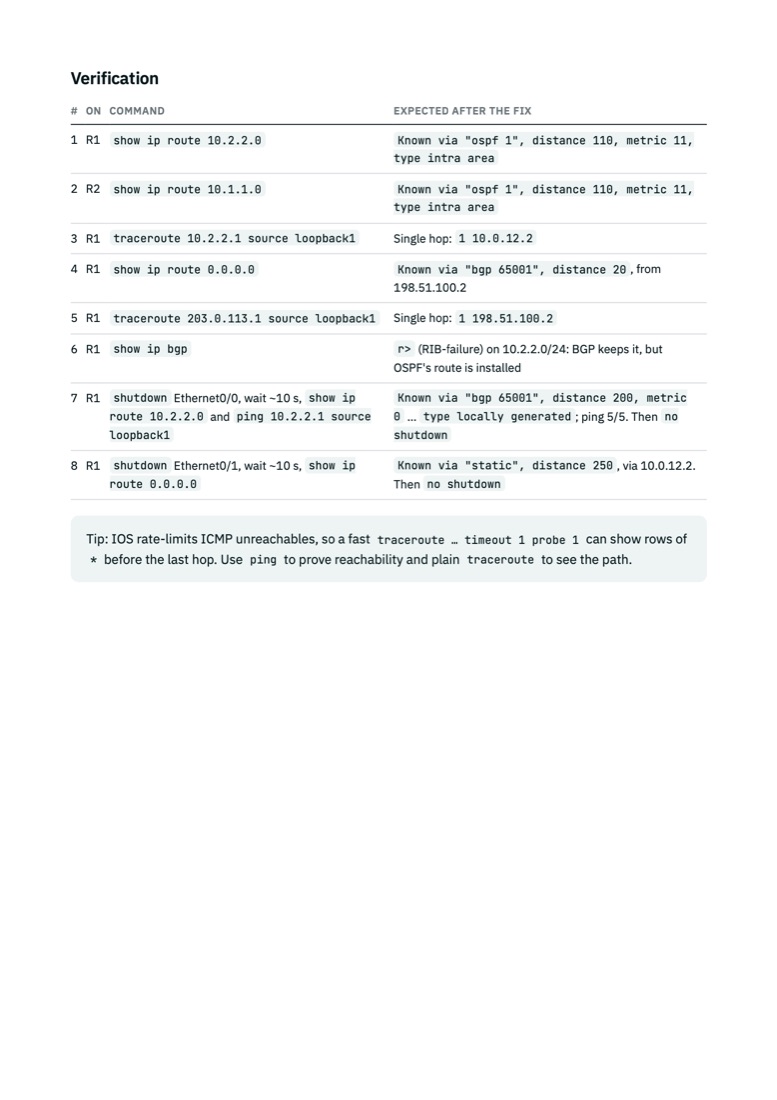
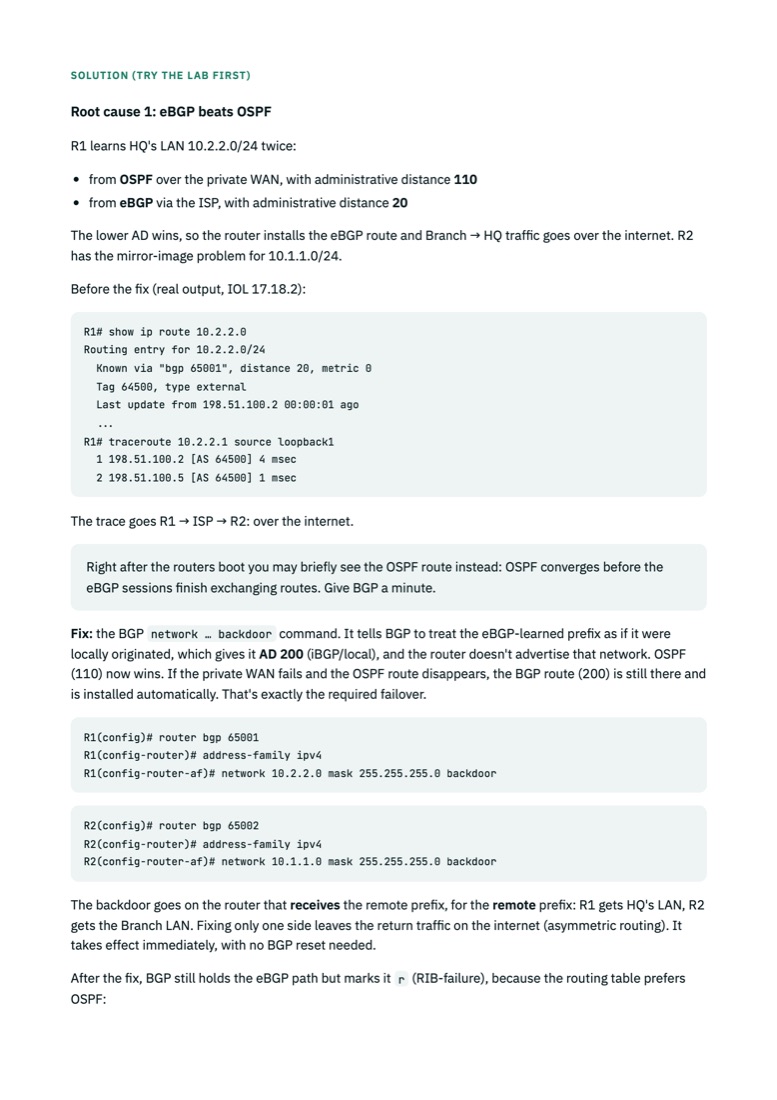
Lab 01 (wrong path), one of the free labs, exactly as it appears in the PDF. Click a page to see it full size.
What you need
A laptop and free software.
- GNS3, free, on Windows, macOS or Linux.
- Cisco IOL images (IOS XE 17.x). They come with Cisco Modeling Labs Free, which you download from Cisco. Images aren’t included in the course: Cisco licenses them to you directly.
- A normal laptop. IOL routers run as lightweight processes, much lighter than full router VMs.
- Prior knowledge at CCNA level, plus your main ENARSI study source, such as the official cert guide.
ENARSI Troubleshooting Labs
Launch price. It goes up to €39 once the first reviews are in.
One-time payment, EU VAT included. Free updates for the 300-410 v1.1 exam.
- 42 labs with tested solutions (PDF workbook)
- Primers, study plan and progress tracker
- Base configs and GNS3 projects for every lab
- 14-day refund if it isn’t for you
Secure checkout by Payhip. Reviewed and verified by a CCNP Enterprise-certified network engineer.
Questions
Are these real exam questions?
No, and that’s on purpose. Every lab is original, written from Cisco’s public exam topics. Using leaked exam content breaks Cisco’s exam agreement and can cost you your certification.
Why IOL and not Packet Tracer?
Packet Tracer only simulates IOS and lacks many ENARSI features. IOL runs real IOS XE code, so the output you see is real IOS XE output.
Do I get the solutions?
Yes. Every lab has a full solution with the root cause, the fix and the real output before and after. In the PDF, solutions start on a new page so you don’t see them by accident.
Is this enough to pass the exam?
It’s the practice half. Use it with a book or video course for the theory. Nobody can promise you a pass, and we won’t.
Who checks the labs?
Every lab is tested on Cisco IOS XE, then reviewed and verified by a CCNP Enterprise-certified network engineer who works with Cisco, Fortinet, Palo Alto, Juniper and Aruba networks.